Written by: 
Fact checked by: 
Responsible gambling pledge by: 
Bankroll management means deciding in advance how much money and time you are prepared to spend on gambling as entertainment. It cannot prevent losses, protect winnings or improve the odds. Its purpose is to create clear financial and time boundaries before a gambling session begins.
This guide explains how to set a gambling budget, divide it into session amounts, choose a stake size, track spending and use safer gambling tools available in Canada. Some online casinos provide built-in deposit, spending and time controls. These tools are most effective when combined with personal budgeting, regular breaks and a willingness to stop when gambling no longer feels controlled.
Important: Gambling always involves financial risk. Bankroll management does not make gambling profitable or risk-free. Never gamble with money you need for housing, food, bills, debt payments, savings, or emergencies.
What Is Bankroll Management?
Bankroll management is a set of spending, time and stake rules established before gambling begins. A gambling bankroll is not investment capital and does not need to cover six months or a year. It is simply the maximum amount a person has decided they can afford to spend on gambling during a defined period.
The concept includes four components, each of which is important for the outcome:
- Gambling budget: The maximum amount allocated to gambling during a defined period, such as a month. It must come from disposable entertainment funds.
- Casino bankroll: Money reserved for gambling and cannot be spent on other purposes.
- Session bankroll: The maximum portion of the overall budget that may be spent during one gambling session.
- Stake size: The amount wagered on one spin, hand or round. It should be selected in relation to the session budget and planned session length.
The process moves from a total gambling budget to a session budget and then to an individual stake. Each amount should be determined before the game begins and not adjusted in response to wins, losses or emotions.
Why Bankroll Management Matters
Beginners underestimate gambling bankroll management, believing themselves to be prudent and insightful. But without a clear model of behavior, even the largest budget can be lost in a single gaming session.
Properly constructed casino bankroll management pursues several goals:
- Limiting the amount available to spend during one session
- Keeping gambling funds separate from essential household money
- Reducing decisions driven by frustration, anxiety, or a desire to make up for losses
- Tracking deposits, withdrawals, total stake and net result
- Ending the session when a financial or time limit is reached
Money management cannot make gambling profitable or remove the house edge. It can only help a person follow predetermined spending and time boundaries.
How to Set a Gambling Bankroll
Proper management of the casino bankroll begins long before the game begins. This is done using the available budget. A common mistake is to set the desired winnings. The calculation algorithm is quite simple:
- Determine your personal net income for the month.
- Basic expenses, including food, housing, and mandatory debts, are subtracted from this amount.
- A reserve fund is created and replenished.
- From the remainder, the entertainment amount is calculated.
- For gambling, funds are used that, if lost, will not affect your quality of life.
- A monthly bankroll is allocated and divided into weekly and session amounts.
Do not replenish the gambling budget after reaching the monthly or session limit. Borrowed money, credit, overdrafts and emergency savings should never be used to continue gambling. Contrary to popular belief, gambling money is not an investment that guarantees profit. It is a portion of your income used for entertainment purposes.
If your income changes or new expenses arise, your bankroll must be reviewed. There is no universal percentage; the portion of funds allocated for games may differ in each new period.
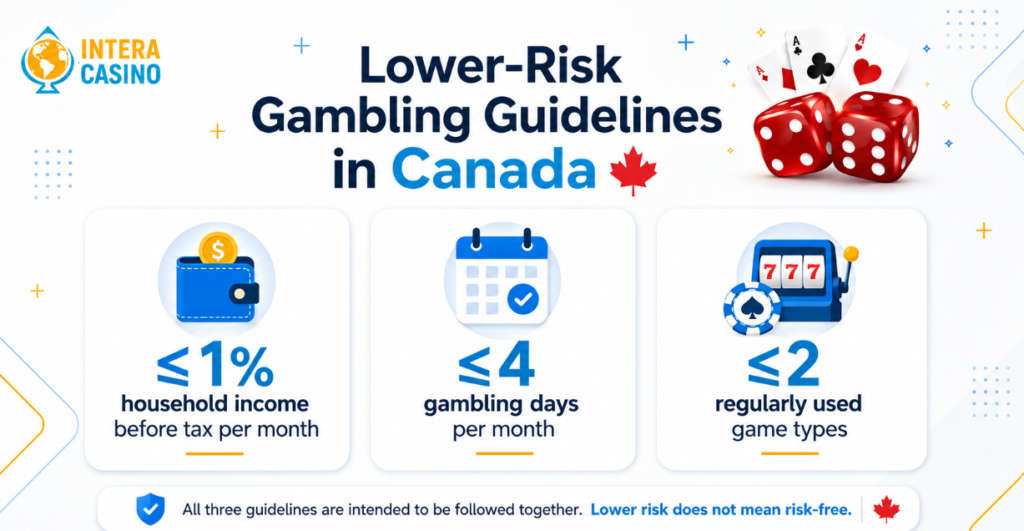
The Canadian Centre on Substance Use and Addiction provides three evidence-informed lower-risk gambling guidelines: spend no more than 1% of household income before tax per month, gamble no more than four days per month and avoid regularly using more than two types of gambling. All three guidelines should be followed together. Lower risk does not mean risk-free.
How to Keep Your Bankroll Separate
One of the most important components of the strategy is to keep your gambling bankroll completely separate from your other funds. To begin, create a spreadsheet for your entire budget, with gambling occupying a separate section. It’s ideal to keep your recreational funds in a separate wallet without an overdraft or credit line.
Money management for gamblers starts with disabling automatic or one-click deposits where possible. Do not treat money displayed in a casino balance as secured income, because it may still be played, require verification or remain restricted by bonus conditions. Record withdrawable winnings separately from the current gambling budget.
Review the casino transaction history alongside bank or payment account records , and record each transaction in a money management tracker. A separate payment method may simplify tracking, but it must not include an overdraft or credit facility. It should also never be used to hide gambling transactions from other people who share responsibility for household finances.
The Mathematics and Psychology of Bankroll Control
The Mathematics
Money management does not improve the result of a spin, hand or round. It only limits the amount of money made available for gambling. In games based on random outcomes, previous wins or losses do not make a future win due and do not “unlock” a slot’s potential.
A smaller stake may allow a session budget to cover more rounds, but placing more wagers also increases the total amount wagered. Because the casino retains a mathematical advantage, a higher total wagered amount normally produces a higher expected loss over the long term.
No staking system changes the house edge. Increasing a bet after a loss, waiting for a winning combination or believing that a game must soon pay are examples of the gambler’s fallacy. Each eligible result is produced according to the rules and probabilities of the game.
The Psychology
Pre-defined limits can reduce the impact of emotional reactions, but cannot eliminate them. Without this system, a losing streak easily turns into tilt, triggering a desire to win back their losses. Winnings also have a detrimental effect on the gambler, artificially boosting confidence and even leading to a sense of control over the game.
Limits strictly control a player’s behavior. They must be set before the game begins and cannot be changed, even in the event of a major win or a significant loss. If emotions take over and betting becomes erratic, it’s best to stop playing, even if the limits haven’t been reached. This will prevent further deterioration and a complete failure of the strategy.
Understanding Variance and Expected Loss
The concepts of variance and expected loss are widely used in online casinos. These concepts are part of the mathematics of money management, enabling approximate calculations of losses. Many players believe they can reduce losses by choosing slots with a high RTP and a certain volatility. However, RTP does not guarantee a win, and volatility only indicates the type of fluctuations, not the probability of winning.
The expected loss depends on the total bet amount, not the deposit. When the balance remains the same and a second spin is performed, the total amount still increases, thereby increasing the potential loss. To determine the expected loss, it’s best to use the formula: total bet * house edge.
For example, if the total amount wagered is C$300 and the house edge is 5%, the expected loss is:
C$300 × 5% = C$15
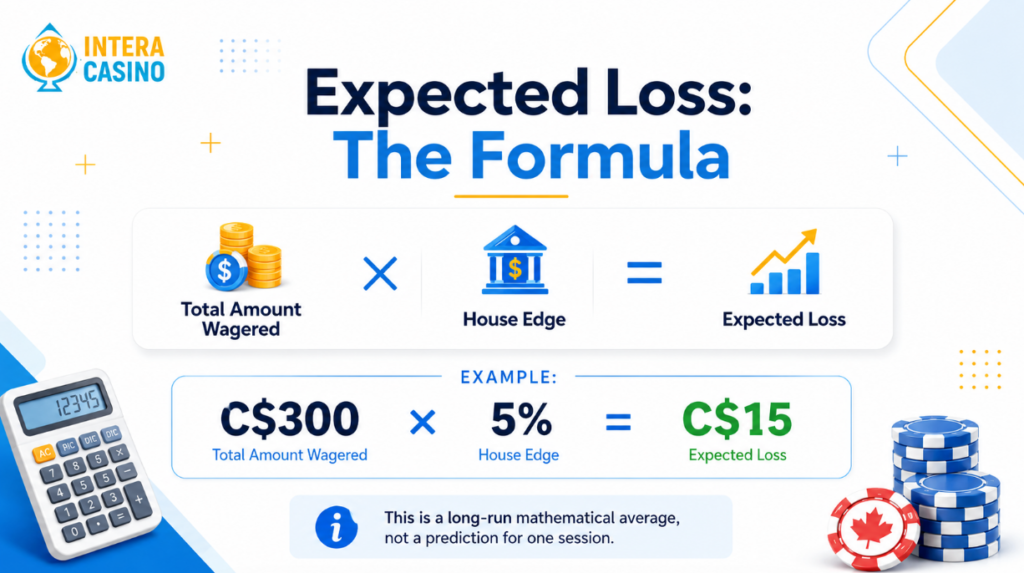
This is a long-term mathematical average, not a prediction that a particular session will end with a C$15 loss. A short session may produce a win, a smaller loss or a much larger loss.
However, online casino bankroll management does not recommend using this amount as a guide, as it operates in the infinite mathematical future. The figures can vary significantly over the course of several sessions.
Managing the Risk of Ruin
Risk money management reduces the likelihood of a complete bankroll loss or a significant reduction. In general, the risk of failure does not mean complete bankruptcy; it only applies to the amount allocated for gambling purposes.
Risk factors leading to bankroll loss include:
- Too high a bet percentage relative to the budget
- Increased volatility of the gameplay
- Prolonged gaming sessions
- Progressive strategy
- Repeated deposits within a session
- No stop limit
- Attempts to recoup losses
- Continuing to play with a significantly reduced bankroll
- Changing the rules due to an emotional reaction
These behaviours can accelerate spending and make a predefined budget ineffective. The following rules may help maintain clearer boundaries:
- Don’t risk large amounts per bet
- Calculate the maximum bet before the session
- Don’t change the spin value. Avoid progressive betting systems
- Don’t top up your account during the same session
- If you reach your stop limit, end the game
- Revise your finances and bets only before a new session
These steps cannot preserve a bankroll, prevent losses or remove the house edge. Their purpose is to reduce impulsive decisions and limit the amount of money exposed during a session.
Choosing a Stake Size
Before starting a game, you need to determine the bet size based on your current bankroll. The bet size does not change the house edge, odds or RTP. A smaller bet usually allows the same session budget to cover more rounds, while a larger bet will burn through your budget faster and create greater fluctuations in cash value.
The purpose of a specific bet is to manage risk, not to preserve or increase your bankroll. A bet that’s too large will quickly deplete your bankroll, while a small one won’t yield any results. Below, we’ll look at the types of bets that can be used in everyday gambling.
Fixed Stake
Professional casino bankroll management tips often mention a fixed bet. It’s set for a specific session and never changes under any circumstances. This makes it easier to manage your balances, eliminating emotional factors and human error.
A fixed bet doesn’t account for bankroll losses. If you experience a significant drop, you should end the session immediately and reassess your bet before starting the next one. However, the house edge remains unchanged, so the risk of bankroll loss remains.
Even if you win or have a winning streak, you can’t change the spin size. This can lead to significant losses in the event of subsequent losses and an overall bankroll imbalance.
Percentage-Based Stake
A more popular option in a money management casino is percentage-based stakes. There’s no universal percentage; calculations are individualized and depend on the pace and desired session length. A decrease in bankroll should be accompanied by a decrease in bet size.
If there’s a temporary increase in budget after a win, the bankroll shouldn’t be increased. Even with a winning streak, an active bonus, or overconfidence, the percentage should remain the same. Players often mistake luck for their own calculations, violating limits. As a result, betting becomes erratic, and the bankroll is eventually wiped out.
Under neutral conditions, percentage-based betting slows down bankroll utilization. However, it can’t overcome the negative mathematical expectation caused by the house edge. This is typical for all gambling strategies.
Bankroll Management for Slots
Online slots differ in RTP, volatility, betting range and game speed. RTP is a long-term theoretical figure and does not determine the result of an individual spin. Higher volatility means that short-term balance movements may be larger, not that a win is more or less likely on the next spin.
For effective online casino bankroll management, follow these rules:
- Limit the spin size.
- Don’t increase the bet after wins or losses.
- Consider the total cost of a spin when selecting more lines.
- Don’t activate autoplay without setting limits.
- Be aware of bonus requirements.
- Remember that wagering previous winnings increases the total amount wagered and therefore increases long-term expected loss.
- End the game after the timer expires or the limit is reached.
Casino bankroll management requires special attention in slots. Rapid rounds, autoplay, animations and frequent bonus prompts can make time and spending harder to track. Use a timer, disable autoplay where appropriate and check the actual cash balance rather than relying on visual effects.
Bankroll Management for Table Games
Online table games have different rules, betting ranges and house edges. Familiarity with blackjack, roulette or baccarat does not remove the financial risk, and no level of experience allows a player to control random outcomes. Blackjack money management is virtually identical to other games, and the general rules are as follows:
- Check the maximum and minimum betting tables.
- Choose a stake that fits the current session budget without relying on future deposits.
- Basic blackjack strategy can influence the house edge, but it doesn’t eliminate risk.
- Roulette money management often involves outside bets, which, while reducing variance, don’t affect the house edge.
- Don’t use tables with higher limits to try to recoup losses.
- Do not apply poker bankroll principles directly to casino table games, because poker involves different opponents, fee structures and sources of variance.
🛡️ Table games are not automatically riskier or safer than slots. The house edge depends on the specific game, rules, player decisions and optional side bets. Review the rules and betting limits before playing, and avoid side bets you do not understand.
Why Martingale Money Management Fails
Martingale money management is a betting system in which the spin amount is doubled after each loss. The hope is that a win will cover all previous losses and even yield a profit equal to the first bet. An example of this strategy is shown in the table below.
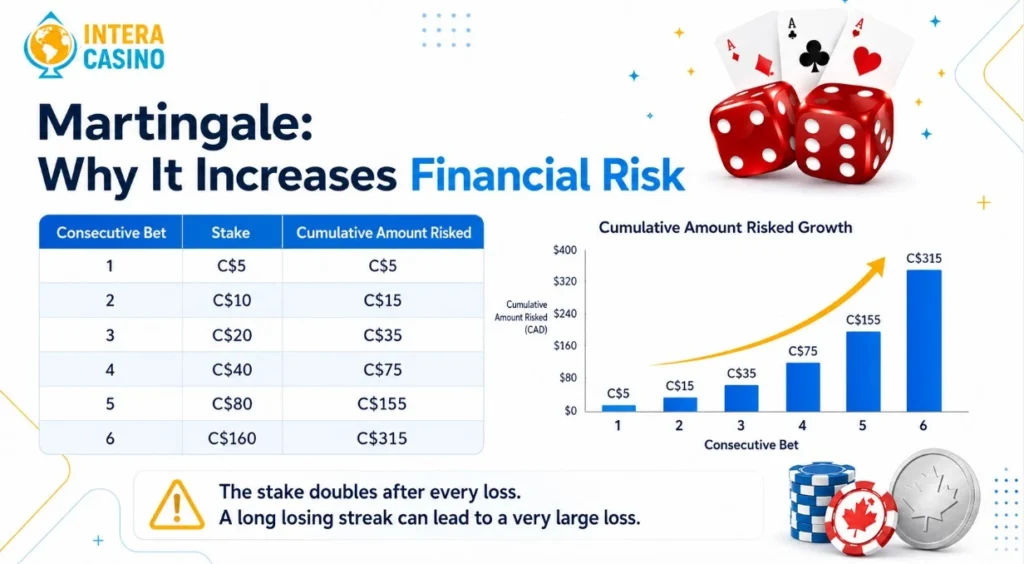
Although the Martingale strategy is popular, it often leads to losses. There are several key factors:
- The stake doubles after every loss, so the required amount grows rapidly.
- A limited gambling budget may be unable to support the next bet.
- The required stake may exceed the table’s maximum limit.
- A long losing sequence can create a very large loss in exchange for a comparatively small target return.
- The progression does not change the probability of the next result or remove the house edge.
Martingale does not create a positive mathematical expectation. It converts a pattern of relatively small apparent wins into a substantially higher risk of losing the allocated gambling budget. Infinite funds and unlimited stakes do not exist in real gambling conditions, and a future win is never guaranteed. The system should not be presented as a method of recovering losses or generating reliable profit.
Set Stop-Loss and Stop-Win Limits
Pre-set exit points can support safer decisions, but they are not guarantees. They work best when combined with operator limits, timers, breaks and access to support. Setting limits looks like this:
- Stop-loss activation: Set the maximum net amount you are prepared to lose during the session. It must not exceed the session budget or affect essential expenses.
- Stop-win activation: Along with the loss limit, you need to set a win limit. An excessively high limit, or no limit at all, will prolong the game, making the total amount too high.
- Conversion to units: From theory to practice, converting approximate values into CAD. For example, the starting bankroll is 150 CAD, the stop-loss is 80 CAD, and the win is 90 CAD.
- Limit activation: The resulting values should be written down in notes or printed. Many casinos allow you to set limits through special tools, usually found in your personal account.
Setting limits alone is usually not enough; a correct reaction is also important. After reaching the threshold, you must:
- End the session without placing another wager.
- Do not make another deposit to recover a loss.
- After reaching a planned win point, stop playing and consider withdrawing the available balance.
- Do not cancel a withdrawal to resume the same session.
- Record the result before starting another session.
Winning, losing, or a long streak of similar results does not change the RTP, odds, or house edge. Exit points simply provide a clear point to stop before frustration or excitement affects your next decision.
Track Deposits, Withdrawals and Net Results
A money management tracker is a useful habit that can be automated. However, it’s best to use a separate spreadsheet and actual evidence that covers:
- Session date
- Operator
- Games played
- Starting withdrawable balance
- Deposits
- Withdrawals
- Total amount wagered
- Ending withdrawable balance
- Session duration
- Cash result
- Current net position
- Notes about mood, triggers or changes to planned limits
Use two separate calculations:
Cash result = total withdrawals − total deposits
Current net position = total withdrawals + current withdrawable balance − total deposits
The first formula tracks completed cash movements. The second also includes money currently available for withdrawal. Do not include bonus funds, locked funds or balances subject to unfinished wagering requirements as withdrawable money.
Compare casino transaction records with bank or payment account statements. Notes about mood and rule changes should be used to identify risky behaviour, not to search for patterns that supposedly predict future game results.
Common Casino Money Management Mistakes
Common money management mistakes are known even to those who haven’t studied the topic. First of all, setting a bankroll isn’t a control tool if a player bends the rules or is guided by emotions. Typical mistakes include:
- Mixing funds: The bankroll is often not separated from money for rent, groceries, and other personal needs
- Borrowing: Using loans, credit cards, overdrafts or money borrowed from another person.
- Overspending: Depositing a month’s amount for a single session
- Increasing the bet: Usually done after a loss to allow for potential wagering
- Increasing limits: This is unacceptable during a session
- Continuing play: Once the limits are reached, it’s unacceptable to continue playing
- Bonus perception: This isn’t free money; it only becomes real once you meet challenging conditions
- Mixing casinos: Multiple accounts on different sites are often used to circumvent restrictions
- Inappropriate state: Gambling under the influence of alcohol, stress, euphoria, or other conditions is uncontrollable
First, try self-diagnosis while playing. If you notice even one of the money management mistakes, you should use a bankroll management system and adopt a more sensible approach to gambling.
Bankroll Management Tools in Canada
Safer gambling tools vary by province or territory and by operator. Before registering, check whether the platform is authorized where you live, which legal age applies and what financial or time controls are available. Ontario’s rules should not be presented as rules for all of Canada.
On regulated Ontario gambling sites, operators must at minimum provide spend-limit and time-limit tools, together with the ability to take a short-term break or use longer-term self-exclusion. Some sites also offer separate deposit and loss limits. Check how each operator defines a “loss,” when a limit takes effect and whether increasing it involves a waiting period.
Ontario residents aged 19 or older can also use BetGuard, a centralized self-exclusion service launched on May 14, 2026. One registration can block access to existing accounts, prevent the creation of new accounts and stop direct marketing from all regulated Ontario online gambling sites, including OLG. Available exclusion periods include six months, one year, five years or a custom term.
Deposit limits, loss limits, time limits, reality checks, cool-off periods and self-exclusion can create useful barriers, but no single tool guarantees control. Consider using more than one tool and do not increase a limit in response to a loss.
If gambling is affecting your finances, time, relationships or emotional well-being, stop and seek support. The Responsible Gambling Council lists free and confidential counselling and helplines for Canadian provinces and territories. In Ontario, ConnexOntario is available 24/7 at 1-866-531-2600.
FAQ
- What is bankroll management?
- How much of my bankroll should I bet?
- Does bankroll management improve the odds?
- What is the risk of ruin in gambling?
- Is Martingale a bankroll management strategy?
- Should I use stop-loss and stop-win limits?